Just wanted to share this article that I came across:
America's five vainest cities, according to The Daily Beast, based on percentage of residents belonging to gyms, body-mass index statistics and average monthly income spent on personal care:
1. San Francisco
2. Boston
3. New York
4. Los Angeles
5. Hartford, Conn.
Chicago came in seventh, but we should've been much higher.
- Chicago Tribune, Section 1, Friday, February 4, 2011
Wednesday, February 9, 2011
Saturday, January 8, 2011
Chinese Halo-halo
This dessert is called eight-treasure health soup (八寶養生湯, read as 'pa-pao-yang-sheng-tang' in mandarin). I call it the chinese version of the Filipino dessert 'halo-halo'. ^,^
It's a mixture of stuffs placed over crushed ice like the halo-halo. The syrup is made of crystal sugar whereas the halo-halo generally uses condensed milk.
The main difference is that continuous consumption of the delicious halo-halo will eventually add to our body weight. =( While long term intake of this dessert will add to the general wellness of one's health such as improved complexion, helps relieves the eyes (specially for those who stares at the tv/laptop screen for long periods of time), and so on and so forth.
It can be consumed over crushed ice or with warm syrup, depending on one's preference. Definitely a dessert for all seasons, whether summer or winter.
I decided to make this dessert tonight. My first try.... ^,^
Anyone of you who happens to be in Taipei, Taiwan can visit Anny's native taiwanese delicacies at:
自由太陽堂 (read as 'tzi-you-thai-yang-thang' in mandarin)
台北市大安區忠孝東路三段227號之1 (No. 227-1 Chung Hsiao East Road Section 3, Daan District, Taipei City, Taiwan)
Tel: (02) 2740-0722~3
Email: meissun6@gmail.com
http://www.is-sun.com/default.asp
She's a close friend of mine and I had my first taste of this dessert at the above store. (costs approx NTD60) Tastes simply great! A must try during your next Taipei stay. While enjoying this dessert, you can grab some native taiwanese delicacies for pasalubong (treats & give-aways). Her stuffs are made fresh daily.

Tuesday, January 4, 2011
Kimchi Hotpot
I wonder how anyone growing up in a tropical country would feel if I say that 1C has by far been one of the warmest temperature this winter season??? lol~


The beautiful snowy winter wonderland scene in our front & backyard comes with a price: freezingly cold!!!
That calls for an easy to prepare kimchi hotpot dinner at home with the hubby. Out came the Korean kimchi we bought at H-Mart which we used as soup base. Then, added the frozen stuffs we kept instock. It does come in handy that we have the habit of stocking our fridge and pantry full of food. ^,^


Hotpot sauce mix is an important part of any hotpot meal. Above, I mixed sacha, soy sauce, vinegar, string onions, & egg yolk (my fave mixture)
Sunday, January 2, 2011
Hotdog's chicken drumstick
Hotdog enjoying some of her holiday treats on her king size bed. (Chicken flavored rawhide drumstick.) Her bed is situated to overlook the main entrance of the house, patio door, and backdoor (garage).
Try snatching that treat from her and you will find your hand becoming a part of her food~~

Try snatching that treat from her and you will find your hand becoming a part of her food~~


Feet Treats!
Typical Sunday morning means checking the newspaper as this is the day of the week where there are tons of ads & coupons on various items for clippings. Items such as beauty & health products, groceries, etc.
I chanced upon an article by Ellen Warren on Chicago Tribune - Feet Treats. She went to the fanciest spa that she could find (SPA by ESPA at The Pensinsula Hotel) and the strip malls to compare manicure & pedicure costs & services.
She compared pedicure treatments:

Nail polish
-High-end, $23: Chanel, Vendetta at chanel.com
-Low-end, $7.29: Sally Hansen, Purple Pulse at drugstores
Ellen says: drugstore polish lasts as long as the designer label, covers as well
Body cream
-High-end, $48: ESPA Deeply Nourishing Body Cream 3.38 ounces at espaonline.com
-Low-end, $3.25: Glysolid glycerin cream at glysolid.com
Ellen says: The expensive stuff isn't worth it
Callus stone
-High-end, $20: Pedro callus stone, Tweezerman at tweezerman.com
-Low-end, $3.49: Callus stone, Equaline at drugstores
Ellen says: The more expensive one is two-sided (rough and fine), and the handle is a lot easier to use; the cheaper one does the job.
Wednesday, December 15, 2010
Instant noodles
As usual, we have our pantry full of stuffs just in case we need a quick food fix but are too lazy to cook or go out, or even call for delivery. =)
This time it's instant noodles straight from Taiwan, which my ever dependable hubby got from his recent trip. Instant noodles are called 泡麵 (pronounced as 'phao-mien' in Mandarin and 'phao-mi' in Taiwanese dialect) in Taiwan or 公仔麵 (pronounced 'kong-chai-min' in Cantonese and 'kong-tzai-mien' in Mandarin) in Hong Kong.
It's made by a famous Taiwanese company under the brand name 康師傅 (pronounced 'khang-zhi-fu'). This one particular flavor is also for vegetarians and without msg added. It's 當歸藥膳麵線 (pronounced 'dang-kwuei-yao-shan-mien-sien'), where I added some mushrooms and an egg. Doesn't do much for the looking but tastes really good, specially added with a taste of sesame oil.

Sunday, December 12, 2010
Hotpot @Yu's Bistro
This is an eat all you can hotpot meal @Yu's Bistro. It cost approx USD14 + tax per person, coz it doesn't come with seafood. The added seafood varieties will cost approx. USD17 + tax.


They call this the Yin-Yang Hotpot (鴛鴦鍋)
This is the soup broth base for a hotpot meal, where one side is the mega-hot broth and the other side mild.
Then, what follows are all put inside the soup broth to boil. We like the veggies boiled till soft while the meat just right. =)


What should always be remembered in each hotpot meal is the concoction of sauce mixture where we dip the meat & veggies before devouring them. Above are the selection of Yu's hotpot sauce mixture (from upper left to lower right): sa-cha paste, sesame paste, chopped string onions, chopped garlic. Not shown is the soy sauce which I added for taste.
I was not able to show what Yu's Bistro looks like before. So, I took a quick shot before we stepped in this time around:

Brunch @Yu's Bistro
We have been to this restaurant 1.5 years ago and was very disappointed with the food quality as its tasted blah. A big embarrassment as we brought the take out to a friend's potluck party. =(
A few days ago, hubby and I decided to give their dinner meal another try. We were surprised as there was a big difference. It's way better. Apparently, it is now under new management. The lady owner told us that her hubby is the chief cook so kitchen quality is well monitored. That's good to hear.
So we went there today to try their brunch. It actually tastes good enough to be added on our regular to-go places. These are the yummy food we had:



A few days ago, hubby and I decided to give their dinner meal another try. We were surprised as there was a big difference. It's way better. Apparently, it is now under new management. The lady owner told us that her hubby is the chief cook so kitchen quality is well monitored. That's good to hear.
So we went there today to try their brunch. It actually tastes good enough to be added on our regular to-go places. These are the yummy food we had:

soy milk (豆漿)
I had the sweetened soy milk but I think it should taste better if they lessened the sugar a teeny weeny bit. Also, I prefer it served in a glass. It also tastes better than the one sold in Westmont, IL. Sigh, that's what happens when you get used to the great food sold everywhere in Taiwan.

Dan-Dan Noodle (担担麵)
This one comes spicy and a bit salty, so be mindful for those who can't take spicy food. As with typical Szechuan dishes, they added pericarpium zanthoxyli (花椒) as with most of their spicy dishes. This leaves your lips a bit numb afterwards. Don't worry as it lasts for only a few seconds. If it's just a bit less salty, I would highly recommend this dish. 
Pan friend bun w/meat stuffing (生煎包)
I guess the strong taste left by the dan-dan noodle has made this one bland. So, I should try this one again the next time we go back to be able to give a fair comment on whether it's good enough to be recommended or a definite blah. =)

Crab Rangoon (酥炸蟹角)
I think I should emphasize that crab rangoon is not a typical chinese dim-sum at all in Asia. I have not seen it in HK, China or Taiwan. In fact, it is only here in US dim-sum restaurants that I have encountered the crab rangoon dish. They are said to be one of the favorites of non-chinese (usually westerners) who frequent the dim-sum restaurants. So far, I can say that Yu's Bistro can be said to serve the best tasting crab rangoon yet. They come with a substantial filling of crab meat w/ saucy fillings (which we usually call crab meat salad) wrapped in those wonton wrappers and deep fried. They are served with honey mustard and/or a kind of sweet sauce (this is not the typical sweet and sour sauce but tastes like the so-called duck sauce that's popular only in US chinese restaurants). The other crab rangoons that I've tried usually have so little fillings that I can't even taste what's in it. You know, like huge fried wrappers with barely anything in the filling. Yu's crab rangoon is best served with dippings of honey mustard and that other sweet sauce. yummy. thumbs up.

Chinese Cruller (油條)
I personally find their chinese cruller too oily. I know they are supposed to be deep fried, but when you tear open the cruller and find the oil almost dripping... it's simply yuck. The ones sold in Westmont, IL by a Taiwanese fast food stand is way better, no oil drips. 
Chinese Chives Pie (韭菜合子)
This is my first time to have chinese chives pie and it tastes- wondeful! As usual, I think that this would have been perfect if its a bit less salty and I don't see the oil dripping. Can you see the oil on the skin? A piece of clean tissue dabbed over it should do the trick. I guess I have been used to food in Taiwan, which means that food aren't too salty, sweet or oily. I guess Taiwanese are just too health conscious.
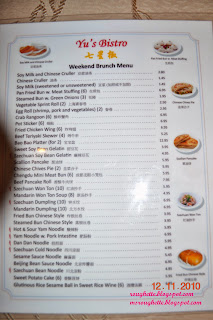
I took photo shots of their brunch menu for those that are curious how much these dishes costs:


As I usually appreciate knowing where we can find good food and new places to dine, I am including their contact information below for reference, hoping that it makes life a bit easier for others:
Yu's Bistro (七星椒)
658 S. IL-59, Naperville, IL60540
Phone- 1.630.8486998
They claim to serve authentic Szechuan, Cantonese, and Taiwanes cuisines.
Wednesday, December 8, 2010
Regular freebies from Victoria Secret
I receive these mail ads from Victoria Secret regularly. They usually give away free undies with no purchase required! You can't help loving them!!!


Tuesday, December 7, 2010
Steamed fish for dinner
Wet markets don't seem to be very popular here in Illinois. The only places where we can buy live or fresh fishes are usually those sold in asian stores. Yes, I mean those fishes that are still swimming around before you got your eyes on them and they got wacked on their head to get cleaned up for your next meal.
Among asians, I bet the chinese people are the most hard to please when it comes to fresh seafood. That means that go where the most chinese live and you should be able to find live seafood.
So off to chinatown I went and got my live fish for tonight's meal. I forgot what fish specie it is. They used a net to catch the fish from the aquarium and confirm with you before wacking it to sleep, remove the scales, etc. Poor fish, but since it's not my pet, I didn't feel really sad. It's the smallest fish in the tank and just good for two people. It cost me approx USD7.
I cleaned it again before steaming it. It's yummy and this is what it looked like:

Cotton Candy
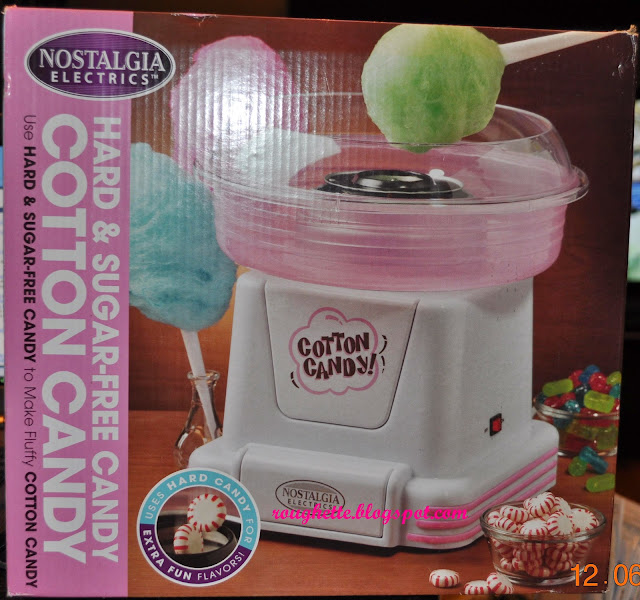
I just purchased this unit and isn't it the cutest cotton candy making machine? It brings back childhood memories where we line up waiting infront of the cotton candy man waiting for our turn to buy a pink or blue cotton candy. Now, I can just pop 2 candies to turn it into a cotton candy! Right at home, without having to go outside looking for the cotton candy man...


Sunday, December 5, 2010
Weekend Dining @Great Steak
The bread at Great Steak Premium Outlet used to be so yummy, coz they toast the bread a bit which they don't now. So, it's not as good as before anymore. But that doesn't mean it doesn't taste good. I'm sharing photos of their 'super steak' meal:


And, this is how the fast food court at Premium Outlet looks like:


And, this is how the fast food court at Premium Outlet looks like:


Monday, November 22, 2010
Hello Kitty Slipper Boots
Don't you think these are just the cutest thing to keep your feet warm this coming white christmas?? All three are such fun colors, which one do you think is the best one to own??? HELP!



* ribbon detail
* side pom poms
* polyester
* machine wash, dry flat


* ribbon detail
* side pom poms
* polyester
* machine wash, dry flat
Chinese Postpartum Care: 3- Recommended Menu 3
3rd Week (Day 15 ~ 21)
Meal: Chicken in sesame oil (麻油雞), Chicken w/chestnut(栗子雞), Chicken w/dang-gui astragalus soup (當歸黃耆雞), Chicken w/lotus seeds & poria soup (茯苓連子雞), Pig tripe w/ spare ribs stew (豬肚燉排骨), Mullet in sesame oil(麻油烏魚), Lamb w/prepared rehmanniae root soup(熟地羊肉湯), Shrimp in sesame oil (麻油蝦)
Black-boned chicken in sesame oil (麻油烏骨雞)- helps the body recuperate, restores vigor
Main ingredients: black sesame oil, old ginger, (taiwan) rice wine, black-boned chicken
Herbals: [生津安神 + 排除脹氣 + 補中益氣] for postpartum care herbal formula
Main ingredients: Radix Rehmanniae Preparata or Prepared rehmannia root(熟地), Radix Achyranthis Bidentatae or achyranthes root(淮七), Ligustici Wa Llichi Rhizoma(川芎), Zizyphi Sativae Fructus or red dates(大棗), Lycii Fructus(枸杞)
To Induce Lactation: Yellow bean papaya w/carp soup (黃豆木瓜鯽魚湯), Stewed Pork feet w/peanuts & mushrooms (香菇花生燉豬腳), lactation herbals
Drinks: Refreshing herbal drink
Sunday, November 21, 2010
Chinese Postpartum Care: 3- Recommended Menu 2
2nd Week (Day 8 ~ 14)
Meal: Pork kidney in sesame oil (麻油腰花), Pork kidney w/Eucommiae Cortex (杜仲腰花), Papaya w/ pork tail-bone soup (木瓜尾椎骨湯), Shi-Quan-Tai-Po w/pork tail-bone soup (十全大埔尾椎骨湯)
*VEGETARIANS: Eucommiae vegetarian pork kidney(杜仲素腰花)
Pork kidney in sesame oil- promotes metabolism, restores vital energy, minimizes against postpartum backpains
Main ingredients: black sesame oil, old ginger, (taiwan) rice wine, pork kidney
Herbals: [(liver & kidney supplement)補肝腎 + (bone strengthening)強化筋骨 + (waist & knee strengthening)強壯腰膝] for postpartum care herbal formula
Main ingredients: Ligustri Lucidi Fructus(女貞子), Cuscutae Semen(菟絲子), Cistanchis Herba(肉從容), Eucommiae Cortex(杜仲), Polygoni Multiflori Radix(首烏)
To Induce Lactation: Yellow bean papaya w/carp soup (黃豆木瓜鯽魚湯), Stewed Pork feet w/peanuts & mushrooms (香菇花生燉豬腳), lactation herbals
Drinks:
Traditional postpartum drink & Red date tea (NOT for labor or vaginal delivery; for caesarian delivery, drink until 12th day)
Refreshing herbal drink (for labor or vaginal delivery; for caesarian delivery, start drinking on the 13th day only)
Saturday, November 20, 2010
Chinese Postpartum Care: 3- Recommended Menu 1
1st Week (Day 1 ~ 7)
Meal: Pork liver in sesame oil (麻油豬肝), Stir-fried Pork liver w/spinach (波菜炒豬肝), Pork heart in sesame oil (麻油豬心), Bass ginger soup (老薑鱸魚湯)
Pork liver in sesame oil- improves lochia discharge off the body, norishes and restores vital energy, protects the liver and eyesight
Main ingredients: black sesame oil, old ginger, (taiwan) rice wine, pork liver
Herbals: [補血養神 + 利水消腫 + 消除疲勞] for postpartum care herbal formula
Main ingredients: Codonopsis pilosulae Radix (黨蔘), Angelicae Sinensis Radix (當歸), Astragali Radix (黃耆), Pearl barley (薏仁), Poria (茯苓)
To Induce Lactation: Yellow bean papaya w/carp soup (黃豆木瓜鯽魚湯), Stewed Pork feet w/peanuts (花生燉豬腳), lactation herbals
Drinks: Traditional postpartum drink (生化湯), Red date tea
Chinese Postpartum Care. 2-Diet Taboo (Don'ts)
1. Avoid drinking water, vinegar or anything sour, rice porridge or congee, including milk, as these are said to easily bring about the sagging of the breasts, skin and internal organs, including protruding tummy, etc.
*In lieu of drinking water, intake of chinese herbal drinks such as sheng-hua soup (生化湯), sesame pork liver soup, etc. during the 1st week is adviced. By the 2nd week, monitored volume of water intake is suggested: weigh body weight daily, such that drink only 10-16cc of water for every kilogram (kg) of body weight, taking small sips.
2. Avoid salt or salty food. Light diet void of saltiness is strongly recommended because it slows down blood flow and is unfavorable to lochia discharge (means post-partum vaginal discharge which contains blood, mucus and placenta tissue. This is very similar to the bleeding experienced during menstrual period, but much heavier.) Salty food may result in thirstiness thereby increasing unnecessary water intake which could cause excess water retention inside the body. This is said to hinder the recovery of the body or physical figure, or cause the tummy to look bloated.
3. Avoid oily food. Postpartum diet is supposed to observe light diet, avoiding oily and fatty food intake. This is said to slow down physical metabolism, causes arteriosclerosis or hardening of the arteries, neuralgia.
4. Avoid raw, cold and spicy food. Breast feeding mothers should avoid these food as they are said to easily cause infant diarrhea. The maternal physique veers toward to a cold nature, causing the hands and feet to easily feel cold during fall winter.
5. Avoid fried, stir-fry or barbeque food, including solid food such as peanuts, (melon) seeds, beans, beef tendon, beef, etc., because they easily result in thirstiness and constipation.
Friday, November 19, 2010
Chinese Postpartum Care, 1-Why is it important?
The modern women has learned to love herself more than ever. She diligently attends her yoga and aerobics classes, a regular patron at spas and beauty salon, goes shopping when she can, the list is endless. All these in the name of health & beauty.
With health comes beauty. Some people turned into vegetarians in pursue of 'detoxing' the body. Chinese medical practice states that a woman undergoes exteme inner physical changes during menarche, postpartum, and menopause. That these stages in her life are the best time to improve (or revamp) her health or well-being through certain practices, which includes intake of certain chinese herbs specifically formulated for each of these stages.
A lot of blood loss happen during delivery or miscarriage, hence the stress on intake of chinese herbals in enriching the blood (補血), norishing one's vitality (補氣), balancing of the yin-yang (補陰,補陽), diuresis (利水), improve blood circulation (活血), etc., to help the body recuperate better.
It is said that the practice of chinese postpartum care actually helps minimize certain ailments such as back pains, rheumatisms, etc., in later years. A friend said she stayed in a postpartum care center in Taiwan for a month after giving birth. She spent a whooping NTD60-70,000 which is about USD2000! She said that there were no visual difference between herself and another friend who didn't practice 'ge-lai'. A few months later, her friend would complain that she easily feels cold, whereas she didn't feel that way prior to giving birth. My friend said that she didn't feel any of those negative issues. My thought? Better safe than sorry.
For those that has no access to chinese postpartum care centers, there are DIY methods available. Finding a chinese herbal store is a must to get the needed chinese herbs.
These herbs should generally concentrate on:
1st week- Detox (排賭淨化, 平補)
2nd week- Activates (調整活化, 溫補)
3rd week- Revitalizes (濕補理氣, 大補)
4th week- Anti-aging (預防老化, 大補)
Thursday, November 18, 2010
Postpartum Care: Chinese Style, intro.
I tried to surf the net for informations about chinese postpartum care and found limited resources in english. And, they mostly introduced why the chinese (race) practice this kind of postpartum care. The more "beefy" information such as do's & don'ts, how-to, what-to-eat, etc., were mostly in blogs that contain chinese characters. Hence, I've thought of researching and sharing these information to those who are interested about this topic but has limited access in understanding chinese characters.
Let's start with the common terms used for chinese postpartum care: "坐月子" read as "zuo-yue-zi" in mandarin chinese (literally means 'sitting the month'), "cho-yut" in cantonese chinese, and called "ge-lai" in taiwanese/min-nan/fookien chinese dialect.
Generally, the chinese postpartum care calls for a 30-45 days 'confinement' of the mother and newborn within the house. There is a also a long list of traditional practices such as no shower or strenuous exercise, shouldn't drink water, etc. Plus, strict menu! These are the traditional or ancient ways.
There were modern twists on these practices, which I hope to share in my blogs lateron. I believe that some of these modern twists will be more acceptable and make better sense to our modern women of today.
Subscribe to:
Posts (Atom)